
The difference between the US and Chinese industrial biotech ecosystems
AI as software vs AI serves biomanufacturing battle

Key points:
Biomanufacturing and industrial capability is priority number 1 in China.
Advanced general purpose AI built on superior compute is priority number 1 in the US.
Private companies have set the US agenda. The government sets China’s agenda.
China is building alternatives to US AI faster than the US is building alternatives to Chinese industrial prowess.
Article:
The US economy - as has been stated ad nauseum now - is a big bet that advanced general purpose AI (not necessarily full general artificial intelligence) will outpace purpose-built applications of AI. Such that the next iteration of Claude or ChatGPT will be able to do whatever application one wants.
In the real world, this looks like Bruce Li, the CEO of TJX Bioengineering documenting his efforts to use ChatGPT to run a bioreactor. His attempts have limitations. But as any one of the general purpose neural networks get better, one could envisage a world where a general purpose AI can run a bioreactor across many use cases.
US companies are betting that compute is the key variable to unlock this potential.
Dean Ball who was one of the lead authors on the US executive Executive Order 14320, “Promoting the Export of the American AI Technology Stack” says this about US-China AI competition:
[US] strategy rests on the presumption that advanced AI is both possible in the near-term and hugely consequential, and that compute is the high-order bit to advancing AI (as opposed to data, scaffolding, clever architectures, and the like). This is not so much the government’s strategy (though at least in the Biden Administration it is true that the senior AI policy planners mostly believed this) as it is the strategy of the leading AI companies and hyperscalers. As such we have pivoted with an alacrity that has been lacking recently in the West.
Because the bet on AI as software is so big, every other emerging technology is subsumed into this effort. Biotech is no exception.
Industrial biotech, biomanufacturing and even biopharma manufacturing have been having a tough time in the US. But US AI firms have been betting big on using AI for biology breakthroughs, just not the manufacturing around it.
Here is where the “general purpose” analogy hits a snag. Much of the money pouring into AI + bio in the US is “general purpose bio AI” where it is not repurposed across every part of the economy, but it is purposed across much of bio. Or it is for drug development. But for the most part AI is being used as software.
A few examples. Alphabet’s AI biotech Isomorphic Labs has $600 million for a drug design model. Eli Lilly and Nvidia teamed up in Oct 2025 to build ‘most powerful’ supercomputer in pharma. Alphabet’s Alphafold Server predicts molecule structure. The Chan-Zuckerberg Initiative’s Biohub plans to cure all disease.
China, on the other hand, is betting is AI can serve manufacturing, particularly biomanufacturing. Our team analysed the twelve announced provisional tech priorities for the upcoming five year plan (2026-2030, to be announced early in the new year).
Embodied intelligence - essentially using AI for manufacturing - is the only direct mention of AI as a priority in the draft documents for the next five year plan, although chips and energy are related to AI.
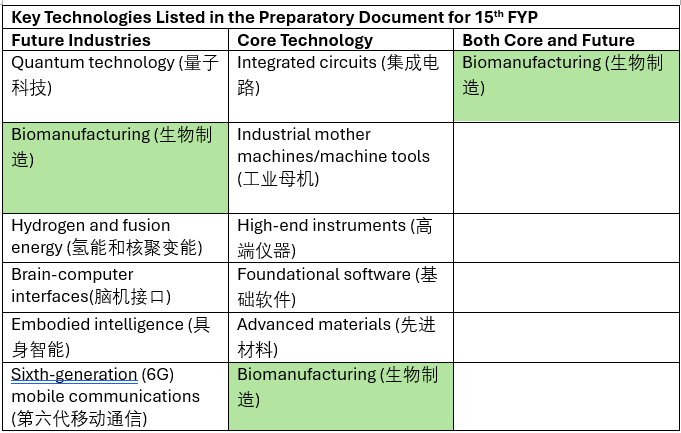
When we look the individual plans of the above technologies, AI is one of numerous tools to bring manufacturing costs down to drive competitiveness. Particularly so in biomanufacturing.
We can see how this manifests itself in an interview with a biomanufacturing company in China:
“Steam prices have been declining year by year. When we first arrived, it was 320 yuan/ton, and now it’s down to 220 yuan/ton. The government is coordinating and supporting businesses in developing green power systems, and our company will begin construction on a 4.6 MW photovoltaic project this year. These practical measures are helping businesses reduce costs and increase efficiency,”
Counterarguments
The counterargument to the above are that Chinese firms have made huge progress on open-source AI model. But this is a different bet. It is a fast follower model that allows near enough is good enough for a fraction of the price. It is not trying to replicate the US model. Rather, it is trying to reduce the advantages at a fraction of the cost and fraction of the compute.
Similarly, one could contend that the US has many strategies to deliver bioindustrial capabilities such as BioMADE, the Department of War’s trimmed down priority list includes biomanufacturing, DBIMP among others.
But, government (as in life) is the business of prioritisation. Biomanufacturing is a Politburo Standing Committee priority in China (the highest priority in the whole country). Biomanufacturing is a DoW priority in the US (the priority of a single bureaucracy). It is not the same.
This is understandable, manufacturing is in many ways a mug’s game. Margins are razor thin.
Many argue that the US is looking to reintroduce manufacturing but that is not with the same urgency as advanced AI as software.