
What do Chinese biomanufacturing pilot facilities look like?
We found one pilot facility in Jinshi City, Hunan

Key points:
The Jinshi plant is part of a bigger local plan to connect the innovation chain from university to commercial product.
The facility got built quickly and cheaply. It was first mentioned in 2024 and went into operation in May 2025 for only 6-7 mln USD. That speed is way faster than an equivalent facility in US/Australia.
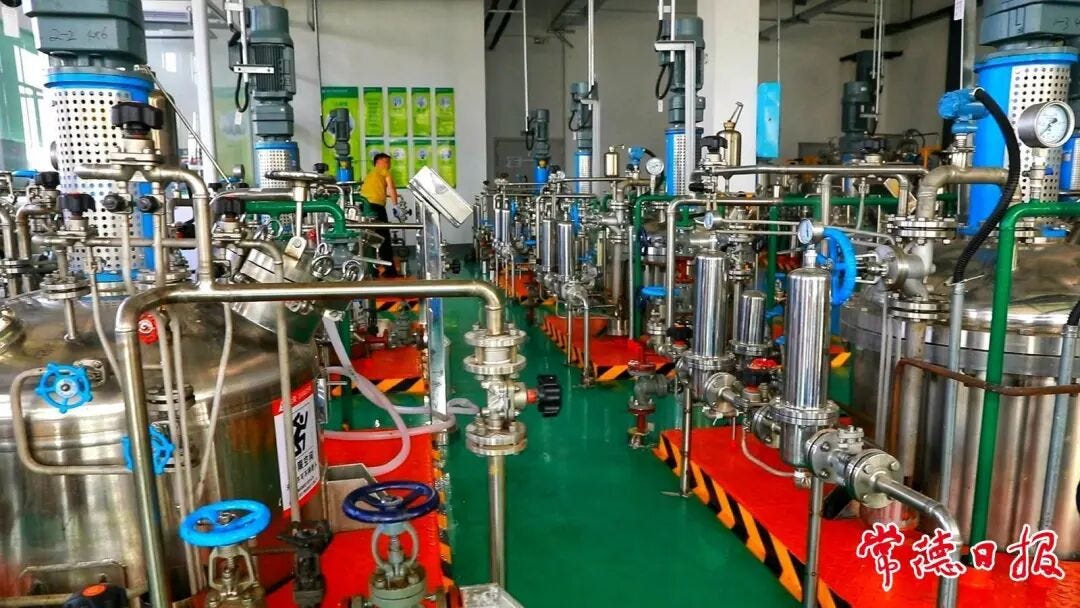
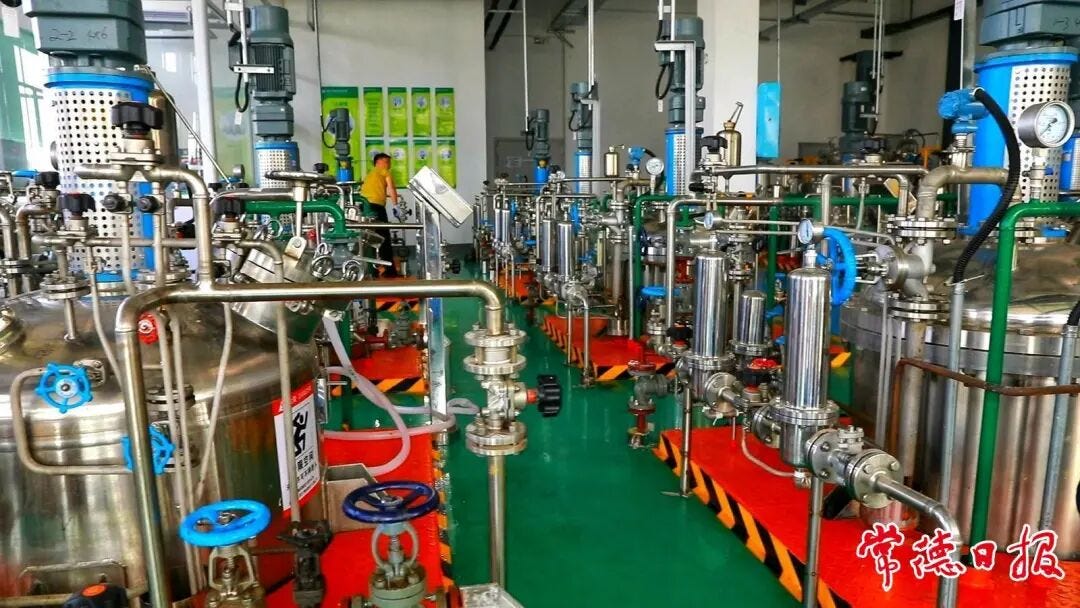
Eight bioreactors are visible in a photo of the facility interior. ChatGPT estimates each bioreactor to be
2300L(thisiswas a low confidence estimate) - one of our readers thinks it might be 200-300L, so total facility perhaps 1600-2400L (again only moderate confidence, but I would take a reader’s assessment over ChatGPT).
In July this year, we reported that China’s Ministry of Industry and Information Technology (MIIT) and National Development and Reform Commission (NDRC) announced plans to build 20 pilot scale biomanufacturing platforms by 2027.
Jinshi (Hunan) has established one such platform. As usual with the Chinese system, there are some caveats:
Some of this is a name-change for political reasons. The establishment of what is now being called a pilot-scale biomanufacturing platform predates the ministerial announcement on biomanufacturing platforms.
There will unlikely ever be a list of 20 platforms - this ministerial announcements strongly encourage provincial governments to build such platforms. But a formal list reduces political wiggle room.
The timeline is as follows:
A sprinkling of biotech firms (mostly pharma) have been operating in Jinshi or neighbouring Changde for years.
Since at least 2022, the government has called this conglomeration of bio companies Jinshi Biotechnology Industrial Park.
In 2024, Jinshi govt announces that it will build the Jinshi bio-manufacturing pilot base. It is only 50 mln RMB (6-7 mln USD) which is inexpensive.
May 2025, the facility goes into operation.
The facility is at the big end of pilot and the small end of demonstration which will naturally vary by product and feedstock. A representative of the facility described it as: “If universities and research institutes focus mainly on the process from 0 to 1, the pilot base can help enterprises achieve the leap from 1 to 10.” [Editors note: Suzhou also appears to have plans for a pilot facility. We will publish on it at a later date, but it claims to go from 1-100 instead of merely from 1-10]
We have information on the facility from two sources: a) a photo (below) that I have asked ChatGPT to analyse and b) some specs from the article itself. Combined it tells us this:
Can run up to five pilots simultaneously
Focused on non-therapeutic applications
Eight bioreactors are visible in a photo of facility interior (there may be more). ChatGPT estimates each bioreactor to be
2300L(low confidence). Please correct me if that estimate looks incorrect - one of our readers thinks it might be 200-300L, so total facility perhaps 1600-2400L (again only moderate confidence, but I would take a reader’s assessment over ChatGPT).Media reporting (admittedly state-directed Chinese media) claims there is a line of companies waiting to use the facility
Feedstocks are unclear
One part of a bigger picture:
The idea - which is common in many technologies and localities in China - is to establish a full incubation system (the local govt’s words not mine) that encompasses:
a scientific and technological innovation platform (whatever that means)
the pilot plant
an acceleration factory (not clearly defined) - I suspect this is a larger demonstration facility or even commercial contract manufacturing (a local official visited the site, so something is at least planned to happen on this front).
and an industrial park (likely a repurposing and renaming of a previously existing industrial park).
There are also pre-existing commercial bio-based food and cosmetics manufacturers in the region, so the pathway from benchtop to product is at least theoretically clear.
Biomanufacturing is just manufacturing, and so much of the price gains are in engineering process iteration and basic cost cutting. We can see how this manifest itself in an interview with a local biomanufacturing company:
"Steam prices have been declining year by year. When we first arrived, it was 320 yuan/ton, and now it's down to 220 yuan/ton. The government is coordinating and supporting businesses in developing green power systems, and our company will begin construction on a 4.6 MW photovoltaic project this year. These practical measures are helping businesses reduce costs and increase efficiency,"
This part of biomanufacturing efficiency sounds a lot like most manufacturing.