

Key Points
A wide variety of facilities are being built NOW from small scale pilot up to commercial
There is a big emphasis on lab to scale pathways.
Industrial biotech produces so many more products than batteries, EVs and solar combined. It will be a pipeline of products for decades.
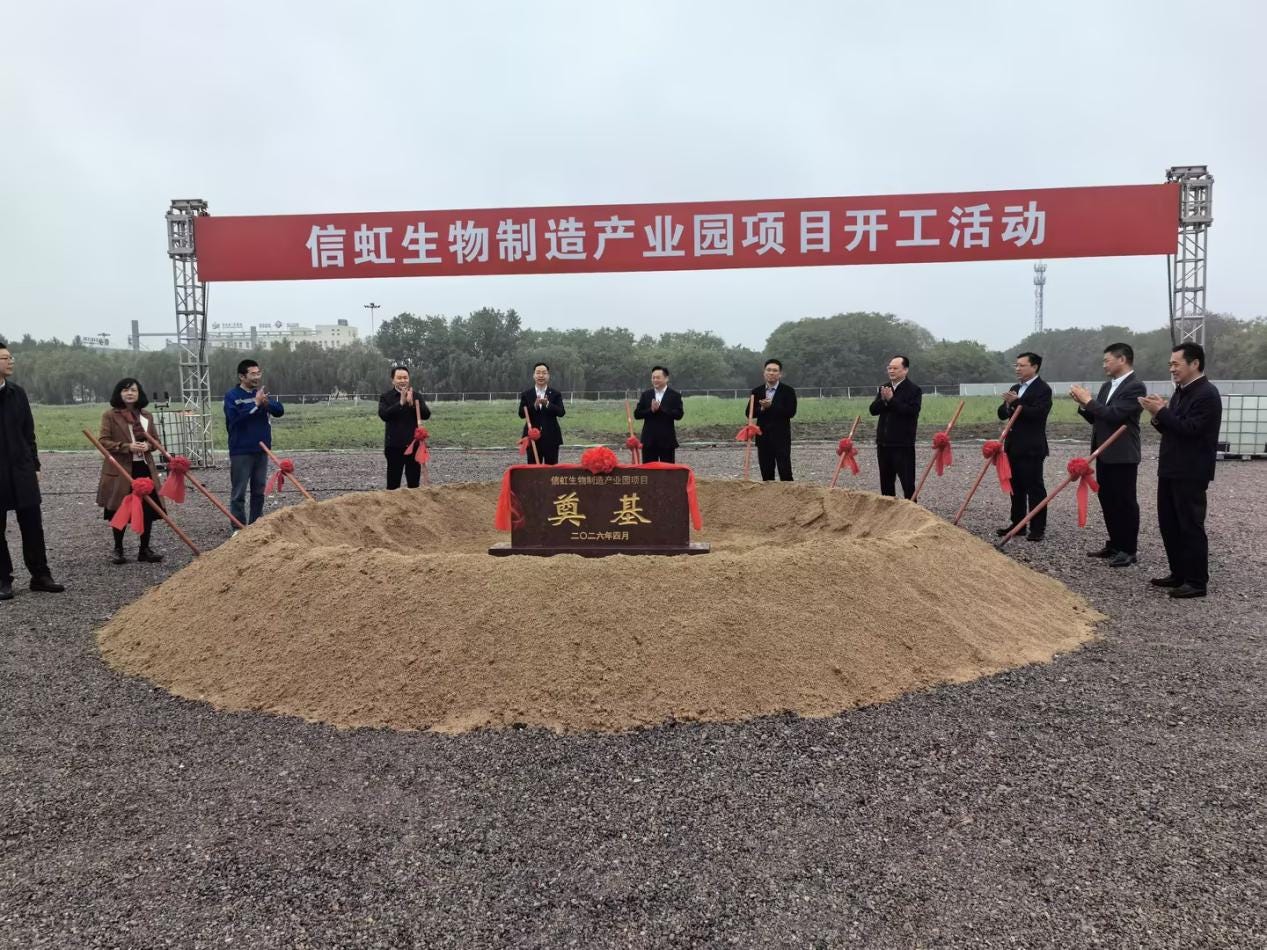
Xinhong Biomanufacturing Industrial Park groundbreaking ceremony
The context
Over the last month, multiple new Chinese “synthetic biology” manufacturing facilities and pilot platforms have come across my desk. Some are being constructed now. Some are agreements to construct.
This is political will turning into projects on the ground.
It feels like other technology booms we have seen where political will turns into huge capacity, knife-fight competition between companies, and significant new commercially viable products at the end of it. This is assessment based on gut feel – I am not comparing current synthetic biology construction with previous levels of construction in China, nor am I comparing with global construction.
Synthetic biology (or biomanufacturing) is somewhat different with previous Chinese technology disruptions. China has a much deeper startup ecosystem now. So, there will be a wide range of scientific innovations working in lock-step with scale and engineering innovation.
Secondly, biotechnology can produce an extraordinarily wide range of products. New products will be added for decades. The pipeline is extremely long. This will look different to EV, batteries and solar cells which is a much narrower group of products that get iterated.
Finally, we could see overcapacity in new industrial bio-based production which given the funding environment in the rest of the world had seemed very unlikely. As the Chinese government says “In emerging industries, we will allow appropriate surplus capacity and encourage competition and innovation.”
What type of facilities are being built?
A wide variety of facilities being built. It is the full stack from high throughput early stage pilot to full commercial for a target molecule.
A lot of end-to-end industrial bases that connect research to scale
Many molecule-agnostic “bases”, “platforms” , “ pilots” etc.
The molecule agnosticism is probably due to local governments and maybe some companies still working out what they want from SynBio. I suspect it is case of start moving and solve problems along the way.
As always (and in many countries), there is a political rebranding of not particularly advanced facilities. The Ruifen facility below appears to producing products (erythritol and allulose) which have long been produced by biomanufacturing.
Gut feel – these facilities look relatively inexpensive for their size
Example facilities
Xinhong Biomanufacturing Industrial Park (信虹生物制造产业园)(Construction commenced in April 2026)
o Total investment of RMB 750 million (~USD 110 million)
o Being led by Jiangsu Jiangshan Pharmaceutical and JLand Biotech – two big traditional biomanufacturers
o End-to-end (research to scale up) of product development
o Wide range of potential applications (probably will be pared down in future): “The project focuses on the research and development and production of high-value-added precision nutrition products, cosmetics and medical devices, pharmaceutical intermediates, and Class II and III medical devices, aiming to build an advanced biomanufacturing industrial base”
The Ruifen Biosynthetic Bio-Industrial Base (瑞芬生物合成生物产业基地项目) in Inner Mongolia (project approved in April 2026 – construction timeline unclear)
o Annual production capacity of 25,000 metric tons of erythritol and 5,000 metric tons of allulose (赤藓糖醇25000吨、阿洛酮糖5000吨)
o The total investment for the project is 300 million yuan (~USD 45 million)
o Allulose used to produced in small amount but has grown due to more widespread use as low-calorie sweetener (so same product, new application). I suspect a lot of allulose plants are going up in China.
o Erythritol – another food sweetener - has faced overcapacity but not so bad now. I suspect yearly production between the products will vary based on price.
Changde Economic and Technological Development Zone Synthetic Biology Manufacturing Pilot Base常德经开区合成生物制造中试平台 (opening in June 2026)
o Two 5-ton fermentation lines, two 20-ton fermentation lines, and one post-processing line with a daily capacity of 20 tons already built
o A 1-ton food-grade pilot line and a 5-ton non-GMP standard pilot line to be constructed.
o Focused on four major sectors: biomedical and cosmetic ingredients, bio-chemicals, bio-agriculture and food, and new biomaterials. (which is a huge part of the economy, so they have not worked out areas of focus yet)
Hangzhou Synthetic Biology Pilot (Validation) Center and Commercialization Base杭州合成生物产业中试(验证)中心及产业化基地
o Equipped (or to be equipped) with multi-stage fermentation, catalysis, and separation equipment ranging from 0.1-liter small-scale tests to 1000-liter pilot-scale tests, it can achieve full-process development and verification from strain design, fermentation scale-up, enzyme-catalyzed conversion to product purification.
o The timeline is a little unclear. I read it as already having some facilities. But I also found a call out for tenders in April 2026 to build a large facility in the same location, so I guess that it will be an expansion of what is already there,
Jiande Synthetic Biology Innovation Industrial Park (Phase II) 建德合成生物创新产业园(二期)(Expected to be completed in October this year)
o No products listed in the announcement, so I assume this is designed to attract a range of potential companies to R&D + manufacture in this location.
o Total estimated investment of over 290 million yuan (~USD 43 million) and a total construction area of approximately 38,000 square meters.
Blue Light Key Synthetic Biology Pilot Production (蓝色光钥合成生物中试生产基地) (Deal signed to build, but no completion date yet)
o 7,000 square meters. It will be supported by “synthetic biology technology + pilot-scale amplification + industrial transformation,” which mean the scale up to industrialisation will be focus.
o Many potential application listed in these announcements: “application of marine functional molecules, further serving the development of the blue ocean economy, non-grain biomanufacturing, precision nutrition and future health industries”
Angel Yeast Phase II of Baiyang Biotechnology Park Project(白洋生物科技园项目二期) (To be operational sequentially in 2027 to 2028)
o 797 Million Yuan (~USD 118 million)
o ~30,000 tonnes of yeast protein annually
o Angel Yeast has existing facilities that are struggling to keep up with demand
More Meat Mycoprotein facility in Guangzhou (to be operational soon)
o Large scale manufacturing of Mycoprotein
o JV between a novel food startup and a traditional big biomanufacturer in China (this will become a very common model – high tech science meets engineering and scale)
o The text above only shows the announcement. But I visited More Meat in April and they said the facility was getting close to production runs.