
China publishes model project list for "Non-Grain Bio-based Materials Industry"
China views harnessing untapped feedstocks as central to unlocking China’s “biologisation” of global industrial chains.


Key Points
The project list, like others we have covered, tells the industrial ecosystem what type of project is a priority
The focus of this list is on R&D such as enzyme strains and saccharification, but there are industrial scale projects too - pointing to a preferred future with more industrial-scale non-food feedstocks.
The plan names two specific industrial clusters - near farmland - to be future leaders of non-food feedstock biomanufacturing
Article
Over the last year, we have covered four model project lists published by China’s Ministry of Industry and Information Technology (often in conjunction with other departments)
These lists serve three purposes. One, they tell the broader ecosystem of universities, local governments, companies and financiers what type of projects are desirable. Two, it funnels money toward projects on the list. Local governments provide moderate subsidies to companies that have projects recognised at the national level. It is also easier to obtain finance if a project is on the list. It is unclear to us whether projects get direct money from national-level MIIT for being on the list. Three, it reaffirms the national government’s broader commitment to biomanufacturing.
In January 2026, the Ministry of Industry and Information Technology and Ministry of Agriculture and Rural Affairs together announced a list of “Typical Cases of Innovative Development in the Non-Grain Bio-based Materials Industry” (两部门关于公布非粮生物基材料产业创新发展典型案例的通知).
This particular announcement is strategically interesting because it again mentions non-grain feedstocks (i.e not competing with food) which builds from a three year plan non-grain biomanufacturing plan (2023-2025). Dirk on his recent trip to China saw companies actively building large scale facilities to convert corn and rice stalks to chemicals. It is also interesting because of the focus on materials. Our team is currently collecting data on global bio-based capacity. One of the early findings is that China is building a lot of bio-based materials capacity.
The announcement divides the cases into three categories: technology innovations, application scenarios, and speciality clusters. ~70% of the focus of this announcement is at the R&D level because turning economically non-food feedstocks into usable biomanufacturing material is still nascent (notwithstanding the notes on Dirk’s China trip above). There are, however, a fair few scaled up projects. So, this list is connecting the initial research to the broader industrial ecosystem.
A full translated table can be viewed here.
Key technology innovations (mostly R&D)
The majority of the announcement (25 out of 35 typical cases) focused on companies targeting fundamental R&D. This covers industrial strain design, enzyme engineering, saccharification of non-grain biomass and development of fermentation platforms.
We can compare this to the 2023 “Three-Year Action Plan for Accelerating the Innovative Development of Non-Food Bio-Based Materials” (加快非粮生物基材料创新发展三年行动方案). Among other goals, this action plan contained a target list of 32 molecules that China wants to manufacture from non-food biomass.
Of the target list of 32, 8 are covered in the new announcement. This provides a clear insight into how firms in China are responding to government targets. The emphasis among firms is towards upstream building blocks for bioplastics and biotextiles, which is unsurprising given government regulations over single-use plastics.
These are mostly at the research level, we have picked out the new advances for these targets:
Application scenarios (larger scale, geared toward to end-use product)
The announcement also recognised 8 application scenario expansions. The distinction between this category and technology innovations (above) isn’t clearly articulated in the document.
Our working assumption is twofold. One, the application scenarios lean more toward end-product products such as PLA bottles or filaments for 3D-printing. This is not a perfect delineation. PHABuilder’s usage of genetically engineered strains is also listed as an application scenario.
Two, the application scenarios also lean toward larger-scale production. With the exception of PHABuilder and ESun, the companies identified here claim to have production capacity of at least 100,000 tons per annum.
Of course, not all of this is from non-grain feedstocks but it indicates that investment in the feedstocks of the future is being shared across the country and not just shouldered by academic labs and early stage start-ups.
This is important, as these companies have already put steel in the ground. Where research in other nations has stalled from difficulty accessing scale-up capacity, future feedstocks are already being introduced at the same industrial plants as existing processes.
Speciality clusters indicates a co-localisation industrial policy
The last part of the announcement was that economic development zones in Anhui and Henan have been identified as speciality clusters: these are industrial areas that are already using non-grain feedstocks and have a broader biomanufacturing base already. It is likely that most of the existing biomanufacturing in these locations is still using corn or sugar.
The Guzhen Economic Development Zone (安徽固镇经济开发区) in Anhui houses the BBCA Group (丰原集团), and in particular its PLA manufacturing base to produce 500,000 mt/y lactic acid and 300,000 mt/y of PLA. Other BBCA subsidiaries in the region are producing vitamins at 150,000 mt/y (Anhui Tiger Biotech Co., Ltd., 安徽泰格生物技术股份有限公司) and amino acids (Anhui BBCA Biotechnology Co., Ltd., 安徽丰原生物技术股份有限公司).
In terms of feedstock, BBCA group uses both food (corn) and non-food sources (straw) to produce PLA, as shown by the pathways below. To our knowledge, only 1,000 mt/y of lactic acid is produced using the latter pathway. So non-grain feedstock are in their infancy in this setting.
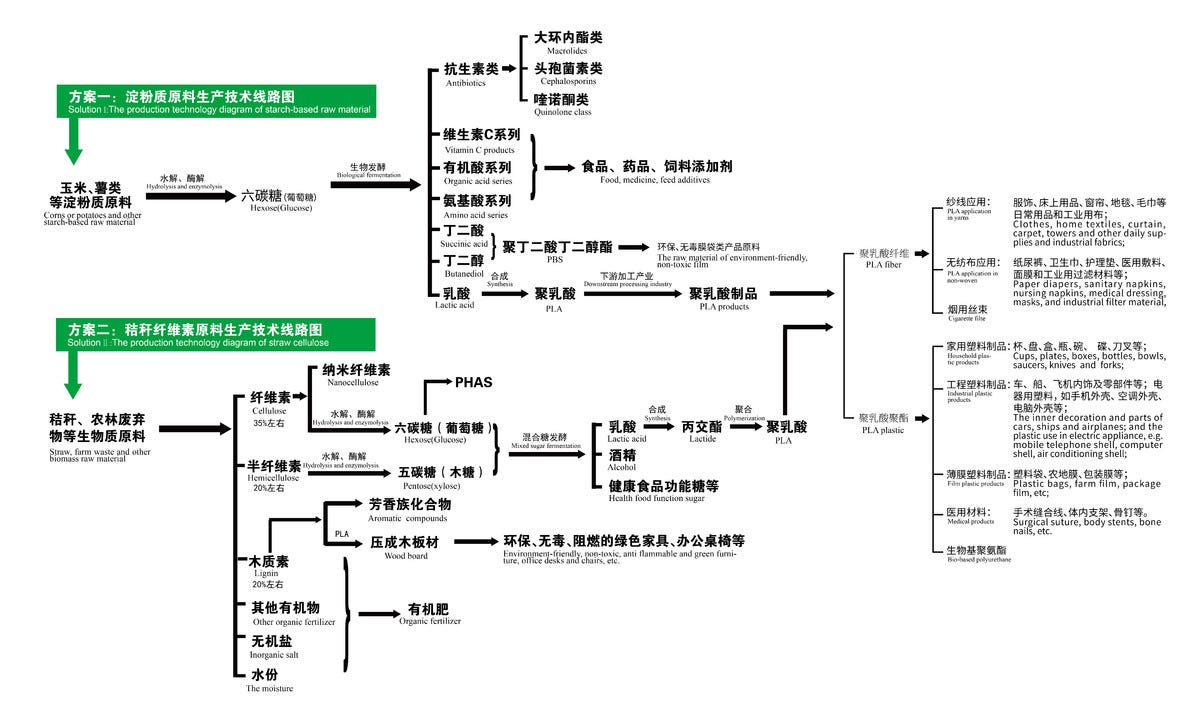
By contrast, Nanle County Advanced Manufacturing Development Zone (南乐县先进制造业开发区) in Henan operates on a multi-enterprise basis. Major players in this area include Hongye Biochemical Co., Ltd (宏业生化股份有限公司), Nanle Shengjiu Sugar Alcohol Technology Co., Ltd. (南乐县盛久糖醇科技有限公司) which operate a 20,000 mt/y xylose facility, and Henan Xinghan Biotechnology Co., Ltd. (河南星汉生物科技有限公司) which produce lactic acid. As of October 2023, the total bio-based material capacity was reported at 800,000 mt/y. Adding to this capacity is a recently announced industrial park to produce PLA and PBAT products, expected to finish construction in 2027. While most of this capacity will rely on food feedstocks, the announcement suggests that forestry residues may also contribute in the future.
Unsurprisingly both of these provinces are among the most productive agricultural regions in the country. Crop straw holds immense potential as a feedstock, with China producing 860 million metric tons annually. This co-location of manufacturing with biomass inputs is the blueprint, and consistently emerges in a lot of bioeconomies because transport of biomass is prohibitively expensive.
While it wasn’t included in this announcement, another area to look out for is Pingdingshan where BBCA has signed a four-party agreement to establish an industrial base using sugars derived from “straw, reed, tree twigs and other agricultural and forestry wastes” (pg 6 of this report) to produce lactic acid and PLA. There have also been previous plans of Shenma Industrial Co., Ltd. to establish a pilot plant for bio-based nylon 66, nylon 6 and related nylon raw materials in this region.
How does this announcement fit into China’s roadmap?
Industrial biomanufacturing is planned to be big business in China. In the short term, there will be lots of sugar from food feedstocks that gets turned into biomanufactured products. That is unavoidable for any country that wants to quickly get novel biomanufacturing to scale.
However, the Chinese government is concurrently laying the foundation to increasingly move away from first generation feedstocks such as corn sugars and sugarcane that are commonplace in biomanufacturing today. As the table earlier in the piece shows, there are companies reaching scale right now.
This is consistent with the prevailing policy paradigm in China that holds that food security is a huge concern. Using feedstocks that could otherwise be used as food will be scrutinised. For example, Jinbei Li reports that a biobased company had plans to go public halted because they were using corn as the feedstock.
It also serves as a reminder that a nation’s resource profiles have big implications for biomanufacturing. As Cam Watson notes, across different regions, we can consistently see that glucose and energy costs are major factors in profitability of amino acid production.
In North America, sugars derived from corn will be the predominant carbon source available to feed the industrial biotech engine. The US views this as a comparative advantage (manifests as lower glucose/‘biological energy’ costs, see the chart below).
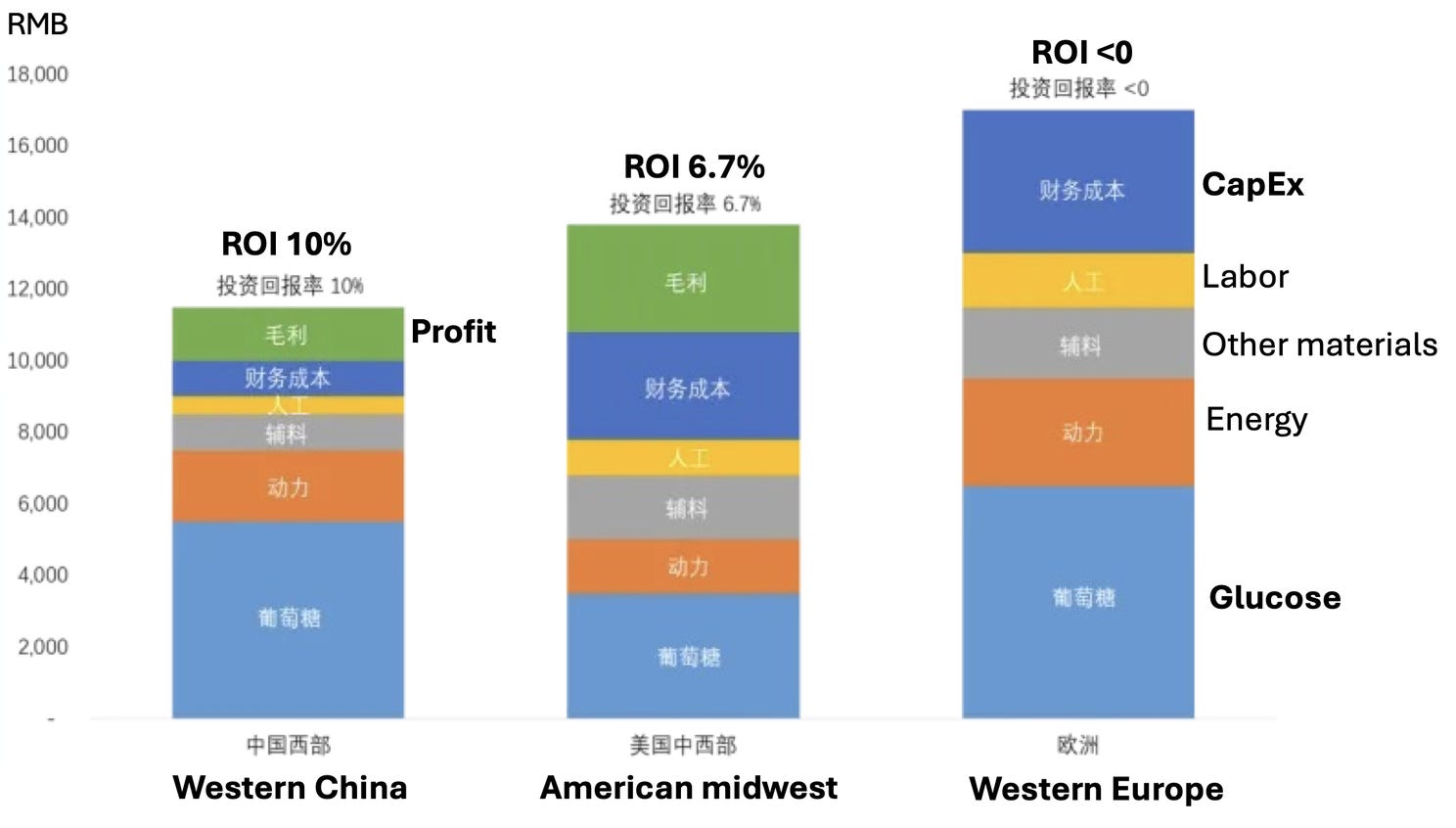
Cost structures of biomanufacturing firms. Source: Cathay Biotech’s Xiucai Liu, annotated by Jinbei Li
 | A guest post by
|
Thanks Arye!
great piece as always Dirk and Tom !